Compare Barbados surf lessons for beginners and kids. See why the south coast suits learners, how group and private lessons differ, and how to book SUP.
Barbados Surf Lessons: Finding the Right Wave for Your Level
Search "surfing Barbados" and the first images you'll find are the barreling reef break at Bathsheba — the kind of wave that's put the island on the map for pro surfers. That's not where you want your first lesson. Nearly every reputable surf school on the island teaches beginners on the south coast, around Christ Church Parish, where the swells are slow, sandy-bottomed, and about as intimidating as a lake on a calm day.
This guide sorts out the confusion between the south coast and the east coast, explains how group, private, and kids' lessons actually differ in what you get, and covers paddleboarding as a lower-key alternative. By the end you should know which lesson format fits your family, your schedule, and your nerve level — and where to start looking once you're ready to book.
Who Each Type of Lesson Suits
Not every surf lesson is built for the same traveler, and the biggest mistake I see people make is booking based on price alone rather than matching the format to their actual goals. A nervous 50-year-old on their first trip to the Caribbean needs something very different from a 10-year-old who already boogie-boards at home.
Complete Beginners and Nervous First-Timers
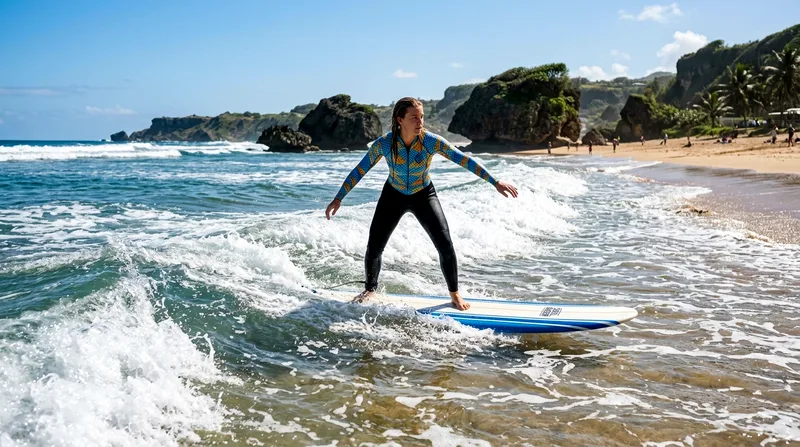
If you've never stood on a board, a group lesson on the south coast is almost always the right starting point. Expect around 60 to 90 minutes in the water, a soft-top foam board (far more forgiving than fiberglass if it hits you), and an instructor who spends most of the first 20 minutes on the sand teaching paddle technique and the pop-up motion before you touch water. Schools like Barry's Surf Barbados and Bodie's School of Surf built their reputations on exactly this kind of patient, beginner-first teaching at breaks like Freights Bay. Don't expect to be riding unassisted waves by the end — the realistic goal for a first lesson is standing up a handful of times with the instructor pushing you into the wave. If you're genuinely anxious about open water, say so when booking; most instructors will adjust the pace and stay closer to you rather than letting you drift to "figure it out."
Kids, Families, and Returning Surfers
Kids' surf lessons in Barbados typically take children from around age 6 or 7, using smaller soft-top boards and a higher instructor-to-student ratio than adult group classes — often one instructor per two or three kids rather than one per five or six. Several schools run short surf camps during school holiday weeks, mixing surfing with beach games to keep attention spans intact. Families often do well booking a shared group slot so parents and kids are in the water together, which also makes photos easier since you're not paying for two separate sessions. Returning surfers — people who've surfed a few times elsewhere, maybe in Portugal or California — usually find the standard beginner group lesson too slow. Ask specifically for an "improver" or intermediate-level booking; a few south coast operators, including Ride The Tide and Dread or Dead, offer sessions pitched above complete-novice level without jumping straight to reef breaks.
South Coast vs Soup Bowl: Where to Learn
This is the single most important decision in planning Barbados surf lessons, and it's geographic, not just a matter of school preference. The island's south and east coasts face completely different open-water conditions, and conflating them is how beginners end up in waves that are frankly dangerous for their skill level.
Gentle South Coast Breaks for Learners
The south coast, roughly from Hastings through to Silver Sands in Christ Church Parish, catches smaller, slower-breaking waves protected to some degree from the open Atlantic swell. Freights Bay is the classic learner break — a sandy bottom, a gentle rolling wave, and shallow enough in places that instructors can stand beside you. This is where most of the island's surf schools, including Freights Bay Surf School, Boosy's Surf School, and Surf in Barbados, run the bulk of their beginner classes. The trade-off is that these waves are also fairly small and inconsistent compared to the east coast, so if you're already an intermediate surfer looking for a real workout, you may find the south coast a bit tame after your second or third session.
Why Soup Bowl in Bathsheba Is for Experts
The Soup Bowl at Bathsheba, on the rugged east coast, is one of the Caribbean's most famous waves and a regular stop on professional surf tours. It breaks over a shallow reef with real power and speed, and the currents and rock formations make it genuinely unforgiving for anyone without solid reef-break experience. I'd actively discourage a beginner from booking a lesson here, no matter how good the photos look — and reputable instructors will tell you the same thing rather than take your money. It's a fantastic place to watch from the cliffs above Bathsheba, or to grab a coconut and some flying fish at a nearby stall while locals and pros ride it, but treat it as a spectator experience on your first trip, not a classroom.
Surf Lesson Formats and SUP Compared
Once you've settled on the south coast, the next decision is format: group, private, kids', or swapping surfing for paddleboarding altogether. Each has a different value proposition, and the "best" one depends entirely on your budget, your patience for sharing an instructor, and how badly you actually want to stand on a surfboard versus just get out on the water.
Group lessons suit first-timers on a budget, while private lessons and kids' classes trade cost for faster, more personalized progress.
Barbados surf lesson formats compared: group, private, kids, and SUP
| Lesson type | Typical duration | Group size | Best for |
|---|---|---|---|
| Group surf lesson | 60-90 min | 4-8 students per instructor | Budget-conscious beginners, solo travelers |
| Private surf lesson | 60-90 min | 1 student per instructor | Couples, fast progress, specific fears |
| Kids' surf lesson | 45-60 min | 2-3 kids per instructor | Ages 6+, families |
| SUP lesson or rental | 60 min (lesson) or hourly (rental) | Varies, often small groups | Seniors, non-swimmers of calm water, relaxed pace |
Typical figures based on common industry practice; exact durations and group sizes vary by school, so confirm details when booking.
Group vs Private vs Kids' Lessons
Group lessons are the most common entry point and the most affordable per person, typically running 60 to 90 minutes with between four and eight students per instructor. You'll get less individual correction, but plenty of south coast schools cap group sizes deliberately to keep quality reasonable. Private surf lessons in Barbados cost noticeably more per person but give you an instructor's full attention for the whole session — worth it if you're traveling as a couple and want faster progress, or if you have a specific fear (like deeper water) that needs one-on-one management. Kids' lessons sit in their own category with smaller boards, shorter attention-span-appropriate session lengths, and instructors trained specifically in working with children. See the table below for a quick side-by-side.
Paddleboarding and SUP Rentals
Paddleboarding in Barbados is the easier alternative if standing on a moving surfboard isn't appealing, or if you're traveling with a senior relative or a child under the minimum surf lesson age. SUP sessions are typically taught in calm, flat water — often in a bay or lagoon rather than on breaking waves — and most people are comfortably paddling within the first 15 to 20 minutes. You can book a guided SUP lesson, join a SUP yoga class (increasingly common along the south and west coasts), or simply rent a board by the hour if you've paddled before. It's a far gentler way to spend an hour on the water, though if you're specifically chasing the thrill of catching a wave, SUP won't scratch that itch the way even a beginner surf lesson will.
What to Look for When Booking
With several schools operating along the same stretch of south coast, the differences that matter are rarely about location — they're about what's actually included and how the operator handles the practical stuff.
Inclusions, Board Types, and Instructor Credentials
Check whether the quoted price includes board rental, rash guard, and photos or video of your session — some schools bundle these in, others charge extra. Soft-top foam boards are standard for beginners and genuinely safer; if a school hands a true novice a hard fiberglass board, that's a red flag. Ask about instructor certification — look for affiliations with recognized surf coaching bodies or lifeguard/water safety qualifications, which several established Barbados schools list on their own sites. It's reasonable to ask how long an instructor has been teaching specifically, not just surfing; teaching beginners is a different skill from riding waves yourself.
Group Size, Safety, and Cancellation Policy
Smaller group caps mean more attention — if a listing doesn't state a maximum group size, ask before paying. Confirm there's a plan for sudden swell or weather changes, since Caribbean conditions can shift within a day; reputable operators will reschedule rather than run a lesson in unsafe surf. Also check the cancellation policy, particularly if you're booking during hurricane season (June through November), when a rainy or rough morning could force a reschedule. A flexible, no-fee rescheduling policy is worth more than a slightly cheaper price with rigid terms.
When to Book Barbados Surf Lessons
Timing affects both wave quality and how easily you can get a slot, and the two don't always point the same direction.
Seasonal Wave Conditions and Best Learning Months
The south coast's beginner-friendly waves are reasonably consistent year-round, which is one reason Barbados works as a surf-lesson destination even outside peak swell season. Winter months, roughly December through March, bring larger, more consistent swells to the east coast — great for watching the Soup Bowl, less relevant for your south coast lesson. For learners, calmer summer conditions (June through August) can actually make early sessions easier, since the smaller swell gives you more forgiving, slower waves to practice on. Compare that with somewhere like Jamaica's north coast, where consistent beginner breaks are harder to find, or Aruba, where the Caribbean side is calm but rarely has rideable waves at all — Barbados's south coast threads a useful needle between "safe" and "actually has a wave to catch."
How Far Ahead to Reserve
During the busier winter tourist season (December to April), it's sensible to book a south coast surf lesson three to five days ahead, especially for private lessons or kids' camps during school holiday weeks, which fill faster. In the quieter summer months you can often book a day or two in advance, sometimes even the same morning. If you're set on a specific school — say Boosy's Surf School or Surf in Barbados — because of a recommendation, build in a buffer day in your itinerary in case your first-choice slot is full or weather pushes the lesson back. Compare current prices and reviews before you book, since availability and seasonal rates shift throughout the year.
Choosing Your Barbados Surf Lesson
If you're a nervous first-timer or traveling with young kids, a south coast group or kids' lesson near Christ Church Parish is the sensible, well-tested choice. Couples wanting faster progress or solo travelers with a specific goal should weigh the extra cost of a private lesson against how much one-on-one coaching actually matters to them. Returning surfers should ask directly for improver-level sessions rather than defaulting to the standard beginner slot, and anyone drawn to the Soup Bowl's reputation should visit Bathsheba to watch, not to learn. Whichever format fits, the next step is the same: compare current south coast surf school prices, reviews, and availability before you book.
Frequently asked questions
Are there beginner-friendly surf spots in Barbados?
Yes — the south coast, particularly around Freights Bay in Christ Church Parish, has slow, sandy-bottomed waves specifically suited to learners. This is where most surf schools run their beginner lessons, as opposed to the powerful reef break at Soup Bowl on the east coast, which is for experienced surfers only.
Do surf schools offer private lessons?
Most established south coast schools offer private surf lessons alongside group options. You'll pay more per person than a group class, but get an instructor's full attention for the session, which usually speeds up progress — useful for couples or anyone with specific anxieties about the water.
How long are surf lessons in Barbados?
Standard group and private lessons typically run 60 to 90 minutes, including time on the sand practicing the pop-up before entering the water. Kids' lessons tend to run shorter, around 45 to 60 minutes, to match younger attention spans.
Can you take paddleboarding lessons in Barbados?
Yes, SUP lessons and rentals are widely available along the south and west coasts, usually taught in calm, flat water rather than on breaking waves. Most beginners are paddling comfortably within 15 to 20 minutes, making it a gentler option for seniors or young children not yet ready for surfing.
What is the difference between south coast and east coast surfing?
The south coast has smaller, slower, more forgiving waves over sandy bottoms, making it the location nearly all beginner lessons use. The east coast, home to the famous Soup Bowl at Bathsheba, has powerful reef-break waves suited only to experienced surfers, with real risks from currents and shallow reef for anyone without that experience.