Discover Barbados Independence Day on 30 November: its history, the parade and festivities, national pride traditions, and tips for visitors joining in.
When Is Barbados Independence Day?
Barbados Independence Day falls on November 30 every year, marking the date in 1966 when the island ceased to be a British colony. It's a fixed public holiday, not a floating one tied to a particular weekday, so the date never moves — unlike some Caribbean neighbors whose national days shift around a long weekend.
For visitors, that fixed date matters. If you're building a November trip around the celebrations, you can plan with certainty years ahead rather than guessing at a moveable observance. Compare this to somewhere like Trinidad and Tobago, where Independence Day also sits on a fixed date (August 31) but the far bigger tourist draw, Carnival, moves with the church calendar — Barbados keeps things simpler.
Flights and hotel rooms tighten up in the days around November 30, particularly in and around Bridgetown, since many Barbadians living abroad return home for the holiday. If you want a central hotel for parade-watching, book at least two to three months out.
Barbados marks independence on a fixed date, November 30, unlike moveable Carnival-linked celebrations elsewhere in the Caribbean.
Barbados Independence Day compared with other Caribbean independence dates
| Country | Independence Date | Year Gained | From | Celebration Style |
|---|---|---|---|---|
| Barbados | November 30 | 1966 | United Kingdom | Formal parade, flag ceremonies |
| Jamaica | August 6 | 1962 | United Kingdom | Festival season, concerts |
| Trinidad and Tobago | August 31 | 1962 | United Kingdom | Parade, overshadowed by Carnival |
| Antigua and Barbuda | November 1 | 1981 | United Kingdom | Parade, cultural shows |
| Grenada | February 7 | 1974 | United Kingdom | Parade, church services |
| Guyana | May 26 | 1966 | United Kingdom | Parade, became republic in 1970 |
Dates are fixed annually; local programming and exact event times vary, so check official tourism sources closer to your trip.
Public holiday rules and weekend observance
When November 30 lands on a Saturday or Sunday, Barbados typically grants a substitute public holiday on the following Monday, so banks, government offices, and many businesses close then instead. The actual independence anniversary and its official ceremonies still happen on November 30 itself, regardless of the day of the week — the parade and flag-raising don't move, only the bank holiday does. If you're visiting specifically to see the ceremonial events, mark November 30 on your itinerary, then check locally whether the following Monday is also a non-working day, since that affects whether shops, pharmacies, and tour operators are open.
Anniversary milestones and themes
Round-number anniversaries get noticeably bigger treatment. The 50th anniversary in 2016 brought an expanded program of events across the island, and round-number years tend to carry an official theme that ties the celebrations together — language around unity, heritage, and national achievement shows up on banners, in speeches, and in school programs. One theme used around a major anniversary referenced "60 and 5," tying the independence milestone to the five years since the 2021 republic transition. If you're traveling for a specific milestone year, check the Barbados Government Information Service website in the months beforehand for the official theme and published program, since exact schedules aren't fixed far in advance.
History: From British Rule to Independence
Barbados spent more than three centuries as a British colony, going back to English settlement in 1627. Sugar, and the slave labor that powered it, shaped the island's economy and society for most of that period, and the legacy of British colonialism is still visible in the island's legal system, cricket obsession, and architecture — Bridgetown's Garrison area, a UNESCO World Heritage Site, is a direct physical record of that colonial military presence.
Independence arrived on November 30, 1966, when Barbados became a sovereign nation within the Commonwealth. Errol Barrow, the island's first prime minister, led the transition and is remembered as a founding figure — his image and words appear regularly in independence-season media and school materials. Queen Elizabeth II remained head of state as monarch of the newly independent Commonwealth world, a status Barbados shared for decades with other former colonies.
Commonwealth world to the 1966 handover
Becoming independent in 1966 didn't mean a clean break from the British Crown. Like Jamaica (independent in 1962) and several other former Caribbean colonies, Barbados became a Commonwealth world, keeping the British monarch as a ceremonial head of state while running its own government, parliament, and foreign policy. This arrangement lasted 55 years. It's a distinction worth understanding if you're comparing Barbados to Guyana, which became a republic immediately in 1970, just four years after its own 1966 independence — Barbados took a much longer route to cutting that final constitutional tie.
Republic Status and Its Place in the Story
Barbados became a republic on November 30, 2021, exactly 55 years after independence. Parliament replaced the monarch with a ceremonial president as head of state, and Sandra Mason, previously the island's governor-general, became its first president. This wasn't a rupture — Barbados stayed in the Commonwealth, kept its parliamentary system, and the transition was framed publicly as completing the work started in 1966 rather than reversing it.
I'd push back on anyone who assumes this was a controversial or divisive moment locally — polling and public commentary at the time suggested broad support, and the ceremony itself, attended by figures including then-Prince Charles, was treated as a point of national pride rather than political upheaval. If you visit now and ask Bajans about it, expect most to describe it matter-of-factly as the natural next chapter, not a contested change.
For visitors, the practical upshot is limited: currency, entry requirements, and day-to-day travel logistics didn't change with republic status. What did change is cultural — November 30 now carries a double significance, independence and republic, and you'll hear both referenced in speeches and media coverage around the holiday.
How Barbados Celebrates on 30 November
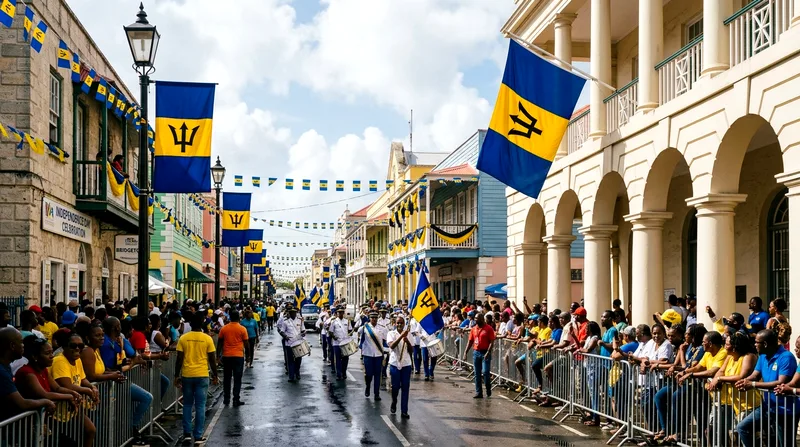
The centerpiece is the Independence Day Parade, typically held in Bridgetown's Garrison Savannah area, featuring the Barbados Defence Force, police, and various youth and cultural organizations marching before government officials and the public. Expect disciplined military-style drilling mixed with school bands, majorettes, and community groups — it reads closer to a formal state ceremony than a street carnival, which surprises visitors expecting something closer to Rio or Port of Spain.
Independence celebrations stretch well beyond the parade itself. There's typically a flag-raising ceremony, a national awards presentation recognizing Barbadians for public service, and church services held across the island in the days surrounding November 30. Fireworks sometimes mark the evening. None of this is staged for tourism — you're watching a genuine civic occasion, and that's part of its appeal if you're interested in Caribbean history rather than beach time alone.
Parade, ceremonies and the national flag
The Barbados flag — ultramarine and gold bands with a black Broken Trident at center — is everywhere during the season: on buildings, cars, clothing, and painted onto curbs and walls in some neighborhoods. The trident is broken deliberately, symbolizing the break from Britannia's trident on the old colonial badge, a detail worth knowing because it explains a design choice visitors often ask about. Flag-raising ceremonies happen at government buildings and schools, usually first thing in the morning on November 30, with the national anthem sung in full.
Traditional food and cultural entertainment
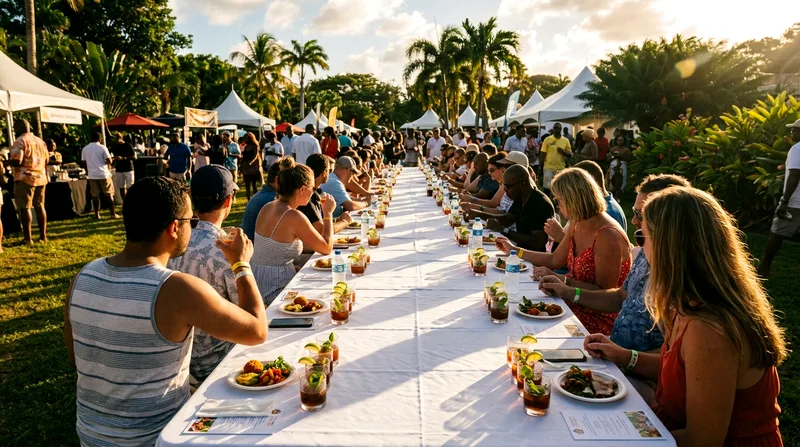
Food stalls and community events around Independence Day lean heavily on Bajan staples — cou-cou and flying fish (the national dish), macaroni pie, pudding and souse, and plenty of rum punch. Cultural entertainment includes calypso and tuk band performances, folk dance troupes, and sometimes gospel concerts tied to church observances. If you're a visitor hoping to try real Bajan home cooking rather than resort versions, this week is a genuinely good time to seek out community fairs and local eateries rather than hotel buffets.
Joining the November Season of National Pride
Independence buildup starts well before November 30 itself — decorations, radio programming, and school events ramp up through the month, sometimes called Independence Season locally. Shops sell flags, pins, and clothing in the national colors for weeks beforehand, and you'll see considerably more of this commercial build-up than in, say, Antigua or St. Lucia around their own independence dates, which tend to be lower-key affairs.
Wearing the colours and national symbols
Many Bajans wear blue and gold, or clothing printed with the flag, throughout the week leading to November 30 — schools often hold dedicated "colours days." Visitors are welcome to join in by wearing blue and gold too; it reads as a gesture of respect rather than appropriation, and you'll see tourists doing it at organized events without any awkwardness. What I'd avoid is wearing the flag itself as clothing (a t-shirt printed as a literal flag draped like a cape, for instance) — some locals find that treatment of the national flag disrespectful, even if it's sold in souvenir shops. Stick to the colors rather than the flag image worn as costume.
Visitor Tips for Independence Week
Expect reduced hours or closures at banks, government offices, and some smaller shops on November 30 itself, and on the substitute holiday Monday if the date falls on a weekend. Larger supermarkets and tourist-area restaurants generally stay open, but it's worth stocking up on essentials a day ahead if you're self-catering. Car rental agencies and tour operators may run limited schedules, so confirm bookings in advance rather than assuming normal service.
Where to stay and getting around Bridgetown
If you want to watch the parade, stay somewhere with easy access to Bridgetown and the Garrison Savannah — the south coast corridor around Hastings or Worthing gives you a short taxi or bus ride in, cheaper than basing yourself further north near Holetown or Speightstown. Road closures around the parade route are standard on the morning of November 30, so driving yourself isn't practical; use a taxi to a drop-off point outside the restricted zone and walk the last stretch. Public buses run but get crowded, and parking near the Garrison all but disappears for the morning.
Respectful ways to take part
Treat the parade and ceremonies as a national civic event you're privileged to watch, not a performance staged for visitors — applaud, don't heckle or treat marching units as a photo prop to interrupt. Ask before photographing individuals up close, especially children in school uniform. If you're invited to a community lime or church event by locals you've met, that's a genuine honor worth accepting; showing up uninvited to private celebrations isn't appropriate. Avoid scheduling anything that requires you to cut through the parade route by car that morning — you will not get through, and trying will frustrate everyone involved.
Frequently asked questions
When did Barbados gain independence?
Barbados gained independence from Britain on November 30, 1966, after more than 300 years as a British colony. Errol Barrow became the first prime minister, and the island remained a Commonwealth world with the British monarch as head of state until it became a republic in 2021.
What date is Barbados Independence Day?
Barbados Independence Day is always November 30, a fixed date that doesn't shift year to year. If it falls on a Saturday or Sunday, a substitute public holiday is usually observed the following Monday, though the ceremonial events still happen on November 30 itself.
When did Barbados become a republic?
Barbados became a republic on November 30, 2021, exactly 55 years after independence. Sandra Mason, the former governor-general, became the country's first president, replacing Queen Elizabeth II as head of state while Barbados stayed within the Commonwealth.
What happens if Independence Day falls on a weekend?
Government offices, banks, and many businesses typically get a substitute holiday on the Monday following a weekend November 30. The official ceremonies, including the parade and flag-raising, still take place on November 30 itself regardless of the day of the week.
What is the significance of November 30 in Barbados?
November 30 marks both the 1966 independence from Britain and the 2021 transition to a republic, since Barbados deliberately chose the same date for both milestones. It's the country's most important national holiday, combining flag ceremonies, a military and community parade, and island-wide cultural events.